AI Implementation in Injection Molding: Crawl, Walk or Run?
AI technology has started to shift from a futuristic concept to a practical, on-the-floor tool over the past months. This is being driven by shortages of skilled labor, a deep-rooted workforce and thinner profit margins. With tens of thousands of technical roles remaining vacant nationwide, forward-thinking custom molders are integrating AI directly into their operations to bridge the gap.
Current Prevalence in Three Primary Areas
Real time process optimization: Tier 1 machine builders are offering closed-loop, self-learning injection profiles that can analyze real-time sensor data and automatically adjust parameters. For example, if a batch of resin has viscosity problems, the equipment compensates instantly to prevent issues.
Quality control: Deep learning AI‑powered vision systems are replacing manual inspections. High-speed cameras can examine hundreds of parts per minute catching micro defects, color variations, surface and warping challenges thus reducing scrap rates that could likely be missed by a human operator.
Predictive maintenance: By pairing sensors with machine learning, molders can track telltale vibrations, hydraulic pressure and valve wear, averting component failures up to 48 hours in advance thus avoiding unplanned downtime.
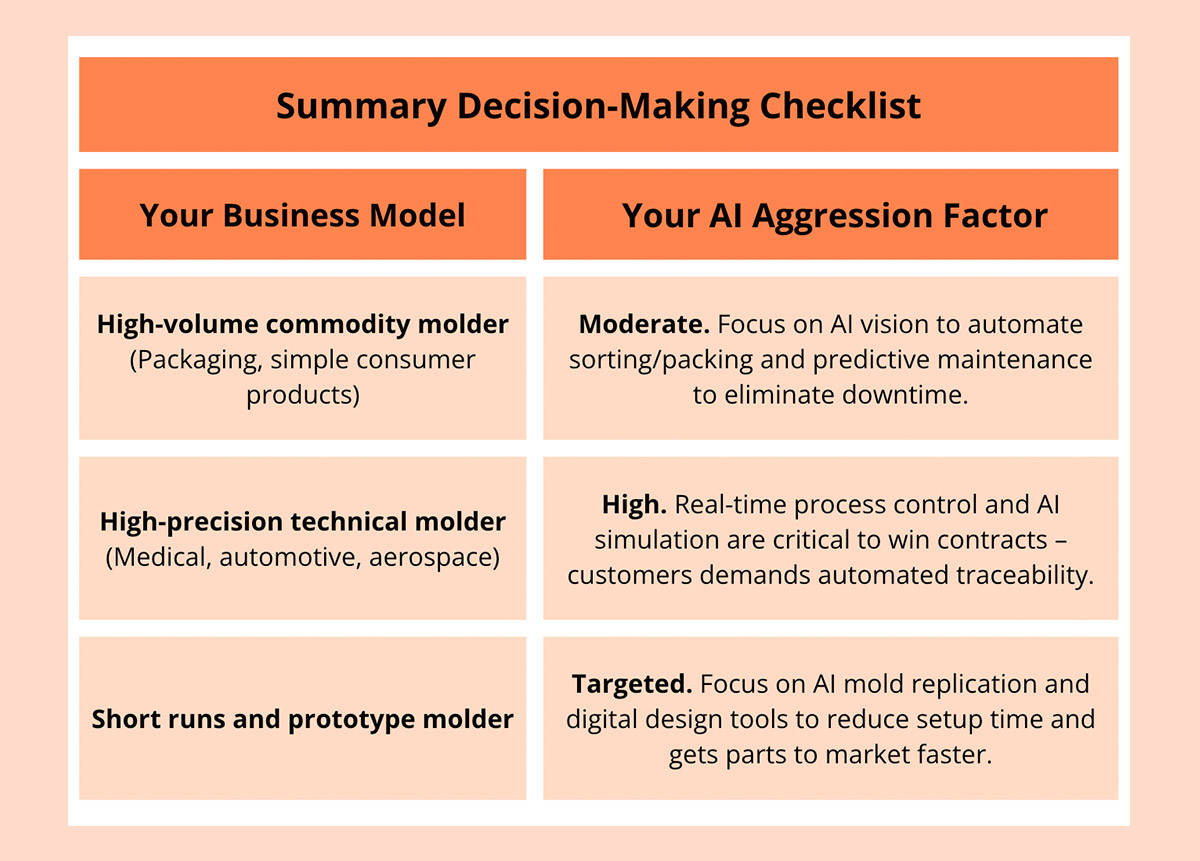
How Aggressively to Implement?
If you’re ready to dive in, the key is being strategically aggressive, not blindly all in. Don’t start purchasing AI software just to say you own it.
Phase 1 – Crawl (immediate)
Focus on low-hanging fruit that doesn’t require an overhaul of your whole process.
Implement AI-driven cameras on high-volume, tight-tolerance lines for quick deployment and assimilation with existing conveyors or robots.
Before cutting steel for a new mold, use modern AI-enhanced simulation software like Moldex3D or Autodesk Moldflow to leverage AI-driven Design of Experiments (DOE).
Phase 2 – Walk (mid-term)
If you still run older hydraulic or early hybrid presses, don’t scrap them. They can be retrofitted with cavity pressure and temperature sensors using a centralized Manufacturing Execution System (MES) and creating the data baseline needed by AI algorithms to scrutinize apparatus efficacy.
The first order of business is to upskill your team in data literacy. Train techs and engineers to read digital dashboards, interpret sensor info and manage automation.
Phase 3 – Run (long-term)
As older machinery is cycled out, prioritize transitioning to an intuitive, all electric or advanced hybrid equivalent featuring closed-loop AI adaptation. As a bonus, enjoy the additional 50% energy savings.
A New Blog for Your Customers
With promising signs of momentum showing in the U.S. plastic manufacturing sector, the industry is operating in a much different economic environment than a few years ago. Production has expanded at its fastest pace in three years, which is great news to most. But energy, transportation and raw materials costs continue to rise. As expenses intensify, proactive maintenance becomes more imperative than ever to remain competitive and profitable. Read more...