Maximize Productivity When Working with High-Temperature Resins
Working with high-temperature performance resins in injection molding presents unique processing hurdles compared to commodity plastics. High melting points, narrow processing windows and thermal sensitivity require strict equipment setups and precise process control. Some of the most common high-temp resin mixes include PEEK (poly ether ketone), Ultem® (PEI – polyetherimide) and PPS (polyphenylene sulfide).
Key performance advantages of hi-temp resins:
Exceptional thermal stability
Superior chemical and environmental resistance
High mechanical strength‑to-weight ratio
Excellent durability
Electrical insulation and flame retardancy
Some of the main challenges encountered include:
Thermal degradation and narrow processing windows
Mold temperature control and crystallinity
Moisture sensitivity/hydrolysis
Equipment wear and corrosion
High melt viscosity and mold venting
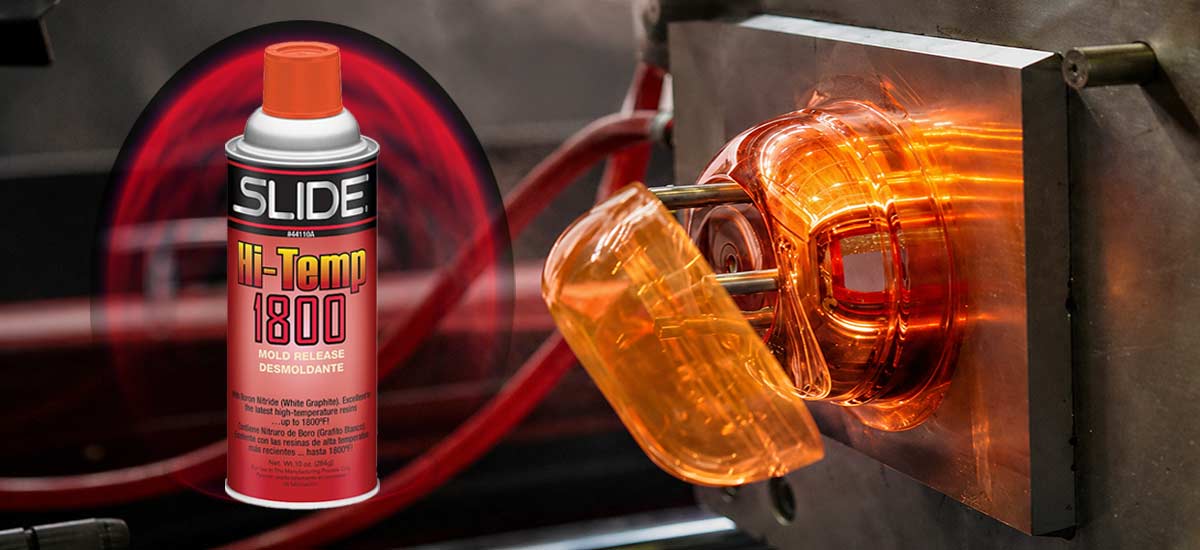
Bring on the Heat – Slide’s Hi‑Temp 1800 Mold Release
The perfect solution to maximize productivity when handling high‑temperature resins is Slide’s non-silicone Hi-Temp 1800 Mold Release (#441). The core differentiator from competitive formulations is its use of boron nitride (often referred to as “white graphite”) as the active release agent as opposed to conventional silicones or organic waxes. Boron nitride retains its lubrication properties and molecular stability up to 1800°F (982°C).
Hi-Temp 1800 will not char, gas off or form gummy carbon deposits on the mold cavity or in vents when processing ultra-high heat thermoplastics. Parts ejected using this product are ready for secondary finishing operations such as painting, sonic welding, hot stamping or adhesive bonding without the need for extensive surface cleaning. An excellent choice for low melting point die‑casting metals like lead, zinc and aluminum, Hi-Temp 1800 provides smooth part ejection for deep draw cavities, thin-walled ribs and complex geometries in engineering-grade resins and glass.
Slide’s factory experts and local distributors are always available to collaborate with our customers to address specific issues and find solutions. Request a free sample so you can try before you buy.
A New Blog for Your Customers
Washing wax patterns before applying the primary coating has often been part of the standard routine for many casting facilities. Removing contaminants and increasing slurry adhesion produces a high-quality finished casting. But washing them frequently doesn’t solve the core problem. Before embarking on this labor‑intensive step, it’s important to ask why cleaning was needed in the first place and how to make the purification process more efficient. Read more...