There’s been an ongoing debate over the years in the injection molding industry about the pros and cons of lithium and synthetic high-temperature greases. Although there has been an accelerating shift toward synthetic lubricants more recently, many molders still stick with the tried-and-true lithium‑based varieties.
Let’s take a look at some of the perceived benefits of each.
PTFE- and Ceramic-Based Synthetics Choices
Traditional lithium grease can bleed, break down or degrade at high temperatures, leading to part contamination.
High-quality synthetic greases comprised of PTFE or silica will not separate or run.
Synthetic formulations can handle much higher temperatures (up to 650°F/343°C) while lithium products usually cap at 300°F - 400°F.
Premium PTFE greases are colorless, odorless and do not release VOCs or harsh solvent smells when heated to high operational limits. Lithiums can carry colors such as white, red, black or green which can create more scrap if there is bleed‑out into the mold.
As opposed to lithium-based greases, they are chemically inert and thus safe for food-grade and medical molding applications and do not react with ordinary molding resins.
Lithium-Based Formulations
Molders that have used these for years in daily toolroom production have adopted a “not broke-don’t fix it” philosophy.
High-temperature lithium complex greases have exceptional metal adhesion properties (tackiness) – “staying put” on moving core pins and slides even under sustained heat.
Lithium-based products are less specialized and can act as a true all-purpose workhorse – often perceived as a “one-grease” shop solution.
Synthetic greases may cost three to five times more than standard industrial lithium selections. So, for standard environments operating below 300°F (150°C), an appropriate lithium complex can provide similar wear protection and thermal stability at a fraction of the price.
The Bottom Line
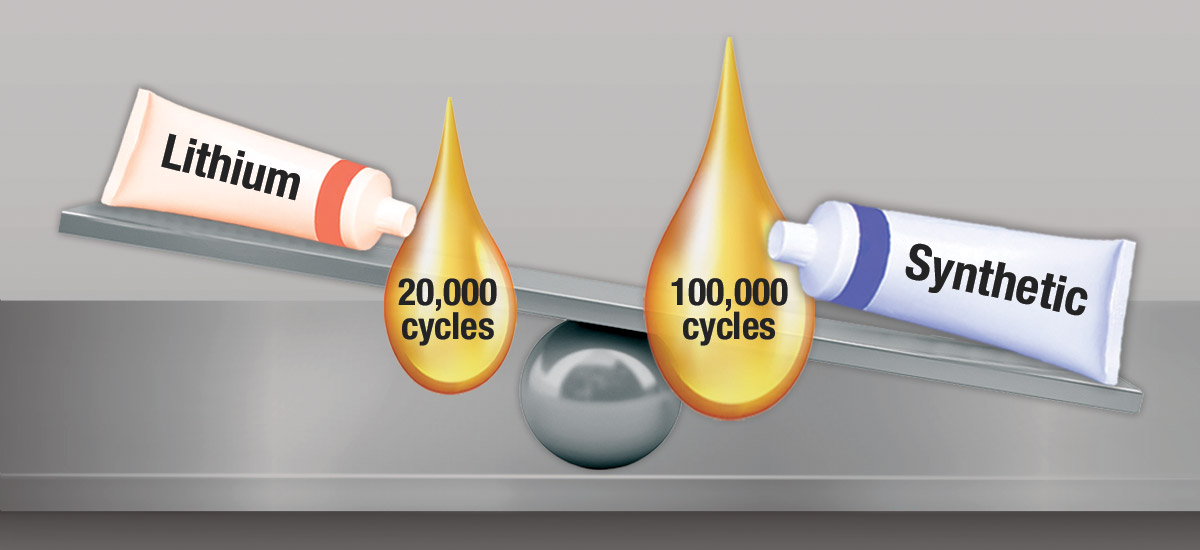
Historically, the higher premium price of a full synthetic grease was a dealbreaker for purchasing departments. But that’s not the big picture – synthetics offer three to five times the oxidation resistance and a mold that used to require a teardown and relubrication every 20,000 cycles could now run up to 80,000 or even 100,000 cycles before servicing.
Scrap reduction is also reduced – stable mechanical shear properties mean vastly lower bleed or migration. In applications such as medical, cleanroom or cosmetic processes, preventing a single batch of parts from being rejected due to grease “weeping” on the mold face easily pays for an entire year’s supply of premium synthetic lubricant.
Slide’s High-Temperature Greases
Our ejector pin greases/lubricants won’t break down under thermal stress and can eliminate pin seizure and part contamination. Both of Slide’s offerings carry NSF approval for use in food-related manufacturing.
Super Grease (No. 439) – PTFE‑based with no silicones and paintable – won’t separate or run with exceptional load‑bearing attributes.
UltraHeat Grease (No. 483) – Ceramic-based lubricant is PFAS‑free, containing no PTFE or silicone – provides excellent thermal and mechanical stability.
Slide’s factory experts and distributor partners are always available to collaborate with your team to find the best possible solution for high-temperature lubrication.
A New Blog for Your Customers
When a customer asks us about a non-flammable mold cleaner, our first question is “What problem are you actually trying to solve?” Reducing fire risk is a valid goal but focusing on only one characteristic can introduce unexpected issues elsewhere. In this article, we explore some of these possible consequences, solutions and why non-flammable does not always mean safer. Read more...