
September 8th, 2026
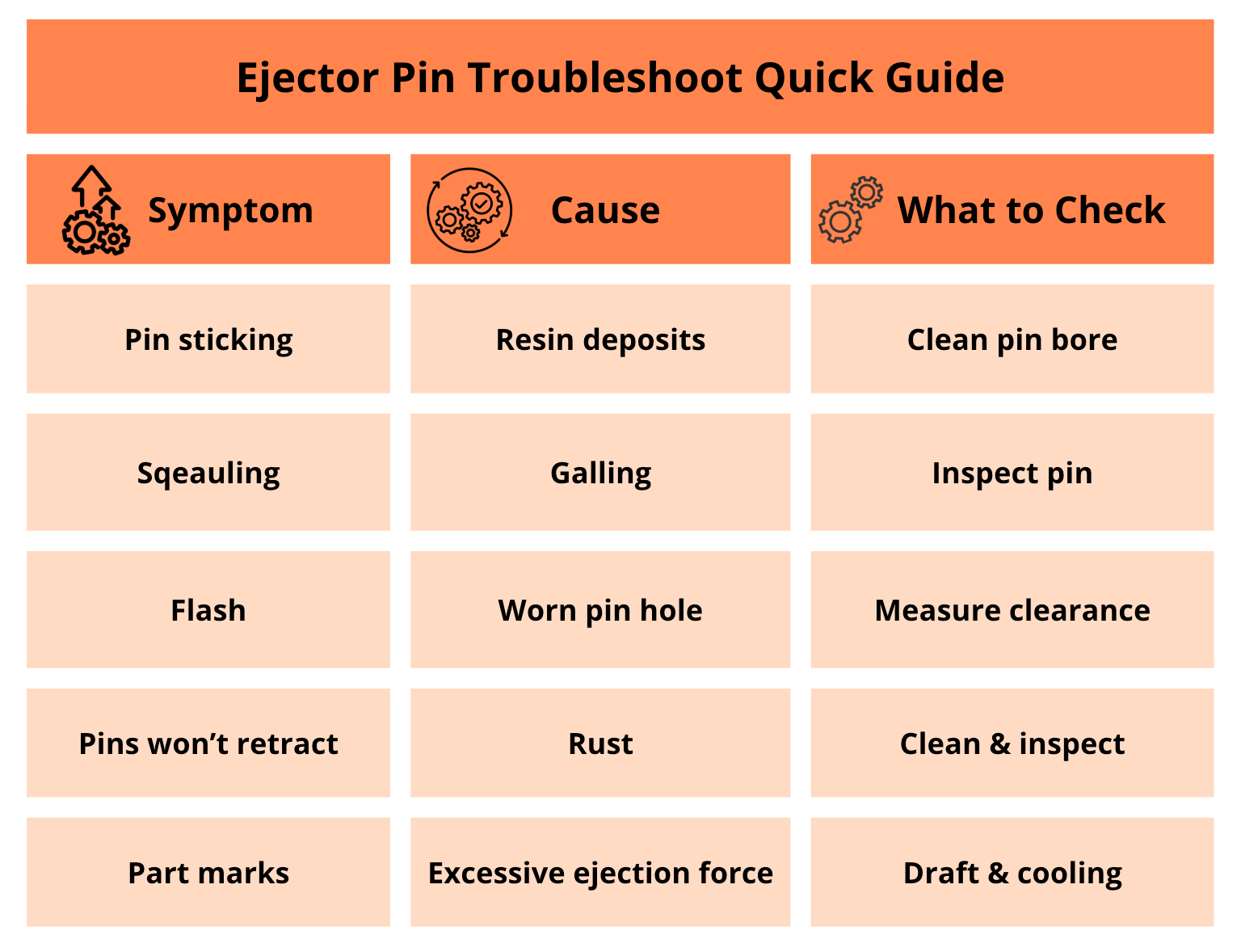
Sticking ejector pins, complete lockup, flashing and visible marks that show up on finished products can all point to problems within the ejection system. Each issue has its own symptom, but many of them stem from the same underlying causes of contamination, wear, corrosion, excessive force or misalignment.
For molders, the most natural response is to treat the symptom – whether that means using more grease, increasing mold release effectiveness or adjusting process settings. While these modifications offer temporary improvement, they don’t always address an actual source.
Identifying the root cause is the first step toward preventing recurring pin hiccups, pricey machinery repairs and unplanned downtime.
“My ejector pin keeps sticking!”
Sticky pins are one of the most common complaints for injection molders and an initial reaction is often to reach for more grease. While lubricants play a very important role during production, adding another layer only masks the actual difficulty rather than fixing it.
When pins can no longer move freely, increased friction leads to galling, seizing or even broken components. Instead of immediately adding grease, take a closer look at what is preventing the pin from moving properly.
Common Causes:
- Resin outgassing and contamination buildup inside pin bores
- Bent, damaged, worn or skewed pins
- Incorrect lubricant choice or over-application
Recommended Solutions:
A consistent preventive maintenance routine would help identify problematic areas before failures occur.
- Clean pin bores regularly
- Remove resin residue prior to hardening
- Inspect pins for damage, scoring or bending
- Replace defective parts
- Apply a compatible product in the appropriate amount
“My parts released, but they look bad”
Sometimes everything can be perfectly aligned but finished parts tell a different story. Visible impressions, dents, discoloration and surface imperfections might indicate that excessive energy is being applied during ejection.
Ejector Marks
Also called pin push, these flaws often appear as shadows, dents, anomalies, white spots and other blemishes from extractor rods pressing against planes. While these markings may have numerous triggers, it usually means that unnecessary pressure was required to eject output from a mold.
Common Causes:
- Too much injection pressure
- Bad part design or inadequate draft angles
- Temperature imbalance
- Insufficient or excess clearance around the pin
- Improper or uncontrolled mold release application
- Rough or flawed cavity surfaces
Recommended Solutions:
- Reduce injection power
- Adjust draft angles appropriately
- Smooth out and polish cavity surfaces
- Check pin alignment and clearance holes
- Apply mold release agent evenly without over spraying
“My pin won’t move at all”
Lockup
When a pin gets completely stuck, the problem might have evolved past just ordinary friction. Seizing occurs when the two metal sides form an adhesion, allowing material to rub and transfer between the surfaces. If left untreated, resistance increases, and the ejector pin will eventually jam up completely.
Once galling starts, adding more lubricant sometimes isn’t enough to curtail damage. Prevention and early inspection are much easier than repairing a frozen system.
Common Causes:
- Inadequate or wrong lubricant
- Rust or corrosion
- Mispositioning within the setup
- Dirty or poorly maintained pin bores
- Exaggerated bonding between moving pieces
Recommended Solutions:
- Protect molds prior to storage with a rust preventive
- Correct misalignment
- Use a high-quality, suitable greaser
- Regularly clean and monitor systems
- Inspect for early signs of galling
When molds sit between production runs, corrosion prevention becomes especially important. Once rust starts forming, resulting friction can create much larger headaches long before molds go back into service.
“Why are my pin holes wearing?”
Ejector pins move through guide holes thousands of cycles. Over time degradation, incorrect configuration and excessive side loading increases clearance between the hole and pin. As the allowance gets larger, the pin can’t travel the way it should. This contributes to uneven ejection, undesirable marks, flashing or additional destruction on tooling.
Common Causes:
- Excessive ribs or thin walls
- Misalignment among movable elements
- Uncontrolled ejection speed or force
- Material or resin conditions that increase adhesion
- Worn out pins or guide components
Recommended Solutions:
- Check alignment throughout setup
- Reduce speeds or pressure where needed
- Review part geometry, wall thickness and draft angles
- Address grip between the part and cavity
- Consider using an alternative material
- Replace or repair worn tooling
Prevent Problems Before They Start
These challenges rarely occur without warning signs. Increased friction, unreliable ejection, visible defects and early indicators of rust can all provide a red flag to intervene before a small maintenance hiccup turns into an expensive production fiasco.
The best troubleshooting strategy isn’t always about finding the quickest way to get a stuck pin back in motion – it’s about understanding why the pin stopped proper transfer at the outset. Proper cleaning, lubrication and corrosion protection—combined with planned upkeep—keep ejector systems operating smoothly while preventing unnecessary downtime and costly repairs.


