

August 4th, 2026
Whether you love them or hate them, Crocs have become one of the most recognizable shoes in the world. From beachside vacationers to red carpet celebrities, these colorful clogs are sold in more than 85 countries, with over 100 million pairs purchased each year, making them a global phenomenon.
What many people don’t realize is that every pair starts with the same high-volume manufacturing process used to create countless automotive, medical and consumer products: plastic injection molding.
History
The idea came about during a sailing trip in the early 2000s, when friends Lyndon Hanson, Scott Seamans and George Boeddecker Jr. discovered a lightweight foam clog that inspired them to create a comfortable, slip-resistant shoe designed specifically for boaters.
After receiving manufacturing rights from Foam Creations in 2002, the first model, The Classic Clog, was introduced at Florida’s Fort Lauderdale Boat Show, where all 200 pairs sold out almost instantly.
What Are They Made of?
Unlike traditional footwear, they aren’t constructed with hard plastic, fabric or leather. Instead, they rely on a closed-cell foam resin called Croslite, which is based on EVA (ethylene-vinyl acetate).
Why EVA?
EVA is widely used throughout the footwear industry because it provides excellent flexibility, durability and cushioning, while remaining exceptionally lightweight. The blend that Crocs uses helps to further enhance all these characteristics, giving them their signature comfort and feel.
Key Properties
- Water and moisture repellent
- Buoyant
- Easy to clean
- Shock absorbing
- Lightweight
- Antibacterial
- Slip resistant
- Odor resistant
Additives
UV stabilizers, pigments and performance additives are also incorporated into the material to create vibrant hues while improving durability and overall performance.
LiteRide
Many newer styles also feature LiteRide, a proprietary mix made to be 25% lighter and 40% softer than Croslite, providing additional cushioning for all day wear.
Why Injection Molding?
Injection molding makes this iconic design possible by combining speed, precision and consistency, all into one streamlined operation. Unlike many other shoes that require multiple components to be cut and assembled, the Classic Clog is primarily molded as a single piece.
This reduces assembly time and helps to achieve uniformity from pair to pair. It also makes it possible to produce large quantities of the same design efficiently.
Manufacturing Process
The process begins by heating the material to about 302-356℉ (150-180℃) until it reaches a moldable state. The melted resin then gets injected under high pressure into specially designed steel molds.
As the foam expands, it fills the entire mold cavity, forming everything from the contoured footbed to the signature vent holes. Once cooled and cured, the final solidified part gets removed from the mold, cleaned up and inspected before packaging.
From start to finish, each cycle usually only takes about three to six minutes. Depending on the equipment and setup, a production line can make up between 5000–15,000 pairs a day.
Quality Check
Every finished pair undergoes a quality check to assess flexibility, slip resistance, durability and dimensional accuracy before being shipped out. Additionally, all products must comply with application regulations, such as RoHS and REACH.
The Details That Made Them Famous
Trademark Ventilation System
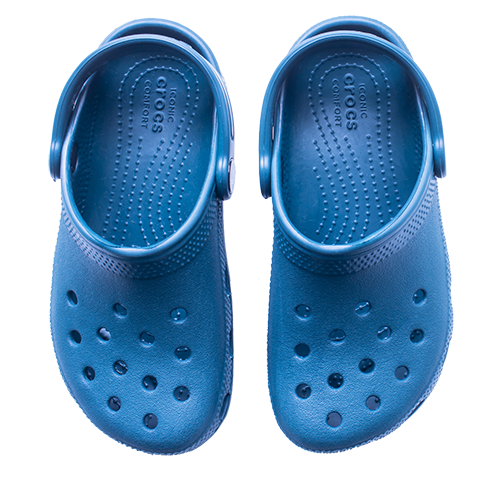
A unique identifier to the brand includes their ventilation system. No matter the size, all Classic Clogs contain 13 top holes to drain water, reduce excess moisture, circulate airflow and maintain freshness.
Jibbitz (Charms)
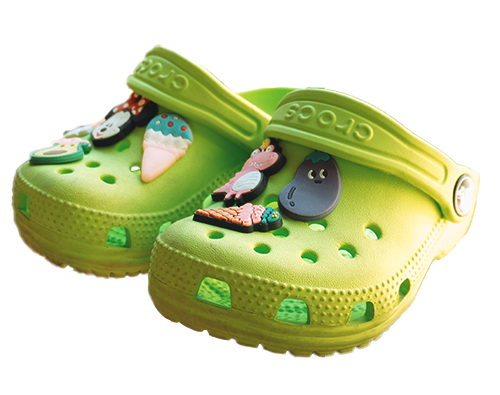
One of the most recognizable features of modern Crocs isn’t the shoe itself, it’s the Jibbitz charms.
In 2006, a Colorado couple felt inspired to decorate their children's Crocs by putting fake flowers and charms into the vent slots. This personal touch became so popular, Crocs eventually acquired the company, turning it into one of the brand’s defining characteristics.
Just like the shoes themselves, Jibbitz are also manufactured using plastic injection molding. Tiny, detailed molds allow for making intricate embellishments in countless shapes, sizes and colors, even across a large production run. The charms can be snapped right into the holes, giving wearers an easy way to customize their own kicks.
More Than Just a Fun Shoe
These fun shoes go to show just how versatile plastic injection molding can be. Whether it’s the shoe on your feet or the tiny charm decorating it, injection molding has played a major role in creating the products that made Croc famous around the globe.


