

October 6th, 2026
Long before plastic pumpkin pails became a Halloween staple, trick-or-treaters hauled around pillow sacks, folded paper bags and metal buckets to collect their candy. Although Halloween had evolved into a nationwide tradition by the 1950s, kids were still toting around heavy tin containers that were prone to rusting, easily dented when dropped and potentially dangerous sharp edges.
Plastic injection molding offered a better solution. By switching to plastic resins, manufacturers could produce high volume batches of colorful candy containers that were lightweight, smooth edged, inexpensively produced and virtually indestructible to withstand a night of trick-or-treating. This once straight-forward utility item used to lug around Halloween goodies soon transformed into one of the season’s unmistakably recognizable symbols.
What Is the Composition of a Pumpkin Bucket?
The classic orange sweet treat holders are typically made from a combination of various kinds of plastics selected for durability, flexibility and affordability. Each one has specific performance criteria, so material choice plays an important role in the outcome.
The Bucket – Polypropylene (PP)
Polypropylene is a popular option because it provides a useful mix of chemical resistance, strength, suppleness and low cost.
Its flow characteristics make it suitable for thin-wall molding, allowing molders to minimize material usage while also ensuring enough tensile strength to survive being thrown on top of a candy pile or dropped on hard pavement.
Colorants can also be incorporated directly into the resin compound to create that bright, signature orange hue without the need for any additional surface painting.
The Handle – Polyethylene (PE)
The carrying handle has advanced along with manufacturing technology, starting as a basic metal wire to eventually becoming a sturdy plastic strap. This component of the design needs load-bearing properties to support holding a mountain of candy, making polyethylene the best fit.
PE has a distinct malleable property, remains lightweight and easy to snap into place. The attachment geometry is just as important as the resin selection itself. Connection points should be properly reinforced and made to evenly distribute the contents once filled.
How Is the Pumpkin Face Made? – Face Detailing
The iconic carved face is what makes this item “eerily” familiar. Depending on design aspects and desired finish, intricate details can be incorporated right into the cavity or added as a secondary operation.
Molded
Raised or recessed eyes, noses and mouths are potentially machined directly into a mold. This integrates features as part of the bucket during injection molding, saving time and money on extra phases. While the initial planning stage requires precise draft and tooling adjustments, the resulting mold ensures high-volume repeatability and eliminates any necessity for down-stream post-processing.
Printing
For a smoother exterior, facial graphics may be achieved through hot stamping or printing. These methods allow greater versatility in characteristic concepts and elaborate detailing, making them better for licensable and distinctive products – but adds a secondary step to the process.
How Does the Pumpkin Get Out of Its Mold?
The shape might look clear-cut, but molding a deep, wide-ribbed container with an often coarse exterior brings ejection challenges to manufacturers.
Texture and depth can increase the surface area contacting the mold. This means the product needs sufficient draft, which is critical to a successful design and to help make the releasing stage more effective.
Draft Angles & Ejection
Molded parts need ample draft to release cleanly from a mold without dragging against cavity walls. This becomes increasingly important if the bucket has a complicated surface or deeper features.
Slightly tapered draft angles allow the finished part to separate from the cavity more easily, minimizing the risk of sticking, scuffing or deformation during ejection. Mold design should pre-determine where the ejector components will safely connect on the pumpkin so as not to leave unwanted marks across visible areas.
Mold Release
A properly engineered mold would free the part without excessive force. When sticking or difficult expulsion becomes an issue, a mold release can be part of the solution.
A quality mold release product can help reduce adherence and improve part discharge when production conditions, surface variations or material attributes make it problematic.
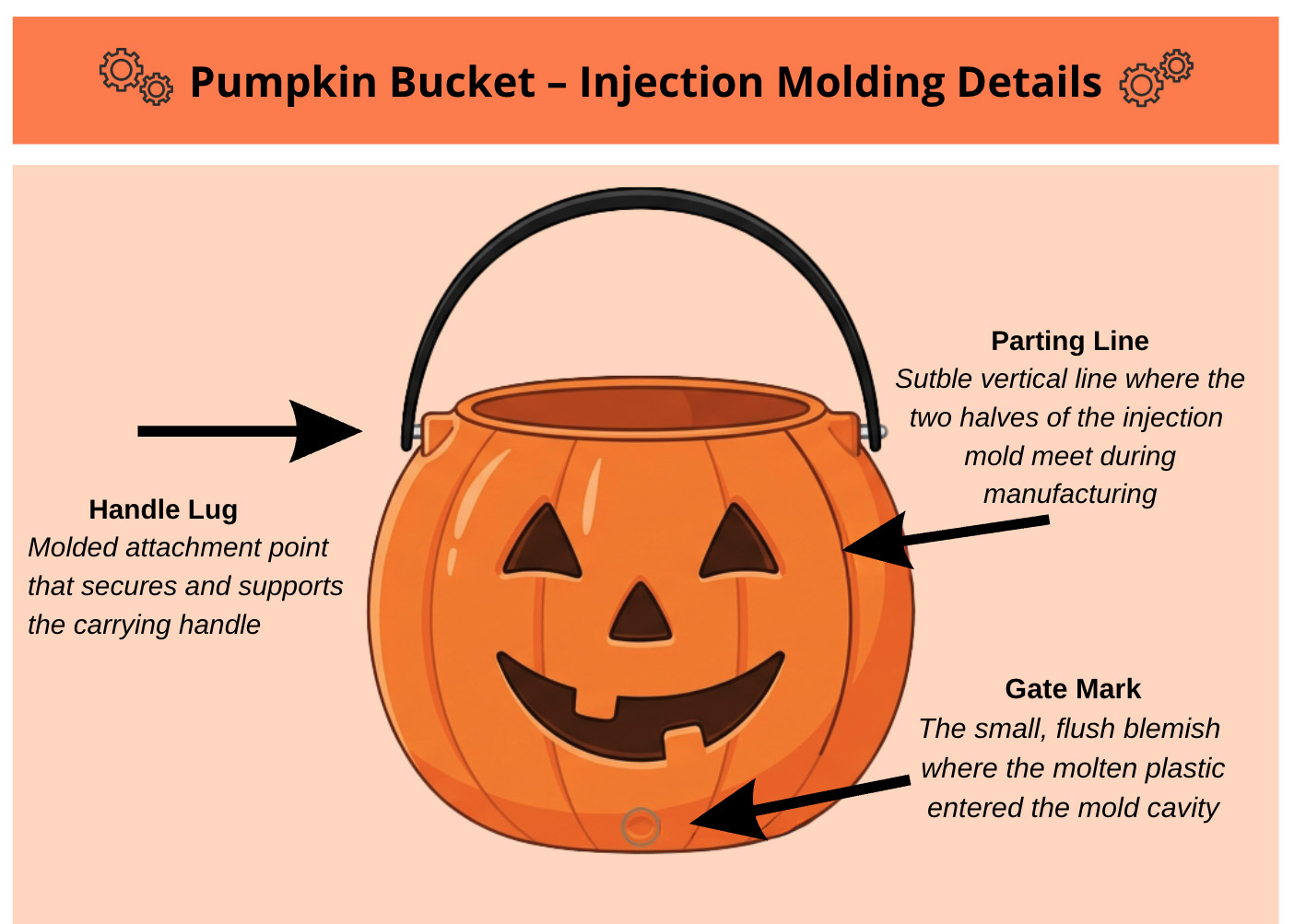
What About the Ribs Around the Pumpkin?
The ridges that run around the bucket aren’t there just for looks. Molded ribs add to stiffness on a thin-walled section without requiring a sizeable buildup in material thickness. This lets manufacturers preserve the lighter weight while providing additional structural support.
Other Molded Halloween Favorites
Next time your town is decked out in fall decorations, take a closer look. You might find some injection molded creations throughout your neighborhood.
Vampire Fangs
Plastic fangs are a great example of small, detailed molded components made with high precision multicavity molding. Depending on the designer and manufacturer, flexible, non-toxic options like food-grade EVA and PVC provide the combination of shape retention and comfort needed to wear them.
Plastic Decorative Skeletons and Bones
Such festive staples consist of multiple molded parts meant to connect/snap/fit pieces like arms, legs and joints to be assembled without the need for extra tools. This keeps the whole assembly process simple.
Halloween Masks
From unassuming plastic costume varieties to detailed character formations, masks rely on injection molding for consistent shapes, surface elements and ventilation. Both material and wall thickness must be carefully crafted for wearability and safety. A mask should be lightweight and comfortable yet rigid enough to hold its shape.
Whether it’s a minimal thin wall pumpkin pail or a multi piece trick or treat accessory, injection molding continues to serve as the backbone of seasonal merchandise year after year. Starting with material choice and mold design to draft, ejection and ancillary decorating, even a modest bucket showcases how much thought and deliberation goes into an everyday molded product.


