
August 18th, 2026
Reject parts, sprues and leftovers from molding projects do not have to get thrown away. With virgin resin prices currently rising, continuing the habit of discarding usable material could quickly become expensive. Repurposing these byproducts allows plastic manufacturers to recycle scrap into new products, reducing their environmental impact and ultimately increasing profitability.
When properly managed and added into suitable applications, scrap resin can be blended with virgin resin to bring down supply costs, support sustainability initiatives and minimize plastic waste – all without sacrificing production efficiency or final part quality.
However, this method isn’t a one-size-fits-all solution. The polymer being reprocessed, how it was originally made and specific requirements for finished parts all need to be considered before determining whether alternative feedstock is suitable for the application.
Closed-Loop System Benefits
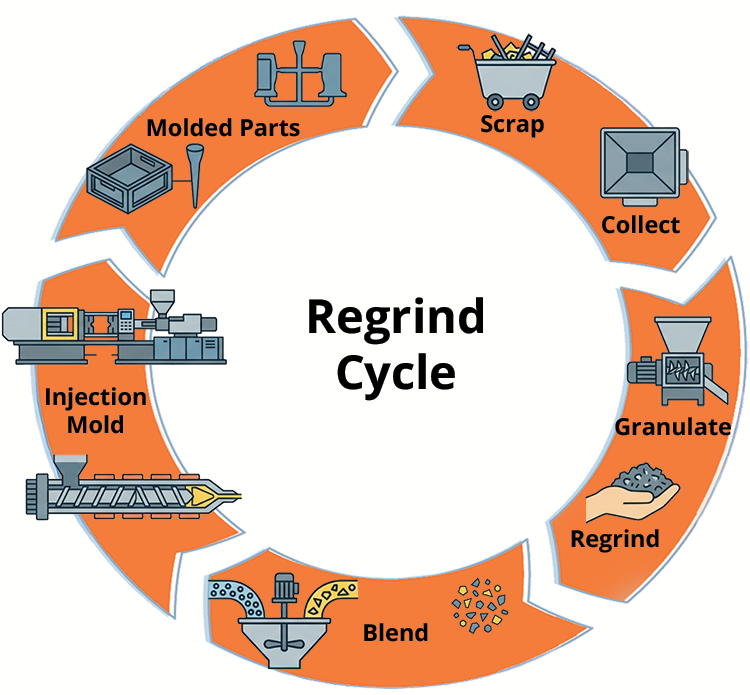
One of the biggest advantages of utilizing recovered plastic resources is the ability to implement a closed-loop recycling practice right into an existing molding operation.
Cold runner systems typically generate higher volumes of reusable material than hot runners because a solidified runner channel enters the waste stream. This enables molders to collect runners, sprues, gates and discard, to reroute directly into granulators for regrind.
Handling this stream in-house gives molders strict control over material impurities and thermal history. Relying on outside salvaging introduces unpredictable risks including cross-contamination or blending errors that could potentially introduce unwanted production variables.
Balancing Virgin Resin vs. Regrind
When deciding whether to use plastic regrind, it’s important to focus on performance factors and not just the potential of cost savings alone. Reprocessed resin is more likely to have different geometries and lower bulk density compared to new uniform pellets, especially when particle sizes differ. Such discrepancies could affect how the plastic feeds through the machine hopper and screw, potentially creating inconsistent resin flow and screw recovery times.
Particle sizes can also influence drying times and overall melting properties within the barrel. Larger pieces take significantly longer to dry and can trap moisture. If left untreated, this uneven condensation distribution causes unplanned fluctuations in melt viscosity, resulting in defects like part shrinkage, warping and unreliable weights/dimensions. Therefore, it’s important to keep grinders and hoppers clean to prevent contamination and maintain a steady pure production run.
Managing Corrosive Outgassing
Thermal degradation is another crucial consideration when working with previously molded polymers. Every time a resin passes through a heated barrel, molecules, additives and flame retardants start to break down. This repeated exposure makes the material more prone to outgassing than virgin resin.
Some of these decomposed byproducts might contain corrosive acids which, over time, aggressively attack polished mold cavities, critical vents and expensive tooling. To protect equipment, molders should use a specially formulated solution – such as an acid vapor neutralizer – which is made to form a protective barrier against these harsh vapors.
Glass-Filled Resins
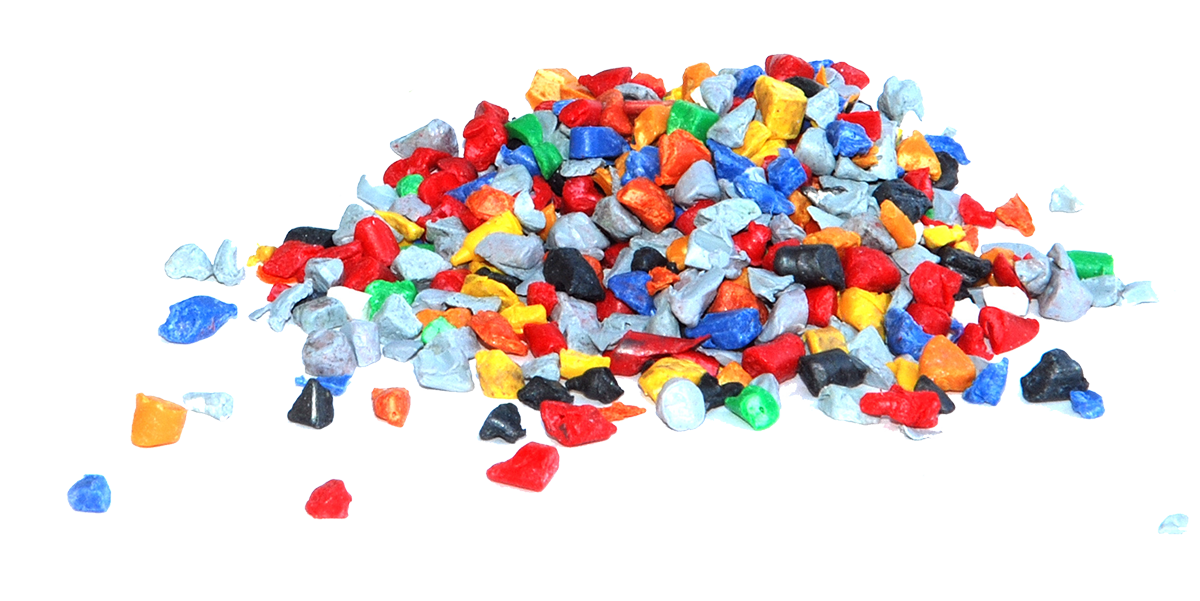
Particularly with fiber-reinforced resins, repeated processing can cause severe mechanical deterioration. The structural and tensile strength rely entirely on the length of internal fibers. When glass-filled scrap resin passes through high-speed granulators, it gets chopped into shards. Once remelted and injected, the structure becomes compromised and can no longer bear as much stress. Consequently, this may ruin the part’s overall structural integrity.
For applications where properties like strength, stiffness and dimensional stability are vital, molders should evaluate an appropriate regrind percentage instead of assuming the same mix ratio will work across different platforms.
Application and Best Practices
Due to the fact reprocessed resin loses most of its original characteristics, properties, strength and consistency, the end use becomes more limited. Melded substrates are best for applications that don’t require food-contact or strict safety regulatory requirements.
Automotive
Underbody parts, wheel liners, acoustic covers and trays
Industrial
Storage bins, shipping crates and handling totes
Agriculture
Irrigation components, fittings and non-food contact parts
Construction
Protective barriers, non-structural enclosures and drainage pipes
Most importantly, to successfully minimize plastic waste without compromising the quality of output, settings should match the regrind blend ratio. Molders might have to adjust barrel temperatures, injection speeds and pressures to compensate for any change in material behavior and viscosity.
Maintaining a dependable proportion and staying ahead on equipment upkeep helps safeguard a predictable outcome. When securely monitored and with the proper parameters, repurposing molding scrap will significantly bring down expenses and turn waste back into profitability.


